
Molecular Networking-Guided Isolation of Cyclic Hydroxamate Siderophores from the Marine-Derived Fungus Aspergillus terreus FM586
Abstract
Hydroxamate siderophores are low-molecular-weight iron-chelating metabolites that are widely produced by fungi to facilitate iron acquisition under iron-limited conditions. Chemical investigation of the marine-derived fungus Aspergillus terreus FM586 was conducted using a GNPS-based molecular networking approach. Molecular networking analysis using the GNPS platform revealed a molecular cluster putatively corresponding to cyclic hydroxamate siderophores. Guided by this molecular cluster, three cyclic hydroxamate siderophores, desmethylenylnocardamine (1), dehydroxynocardamine (2), and nocardamine (3), were isolated. Their structures were elucidated by HR-ESIMS and NMR spectroscopic analyses, together with comparison to published data. The corresponding Fe(III) complexes of compounds 1–3 were subsequently prepared and characterized by HR-ESIMS, providing additional evidence supporting Fe(III) coordination by these hydroxamate siderophores.
Keywords:
Aspergillus terreus, Siderophore, GNPS-based molecular networking, Fe(III) coordinationIntroduction
Siderophores are low-molecular-weight ferric iron-chelating compounds produced by aerobic microorganisms to acquire and transport iron under iron-limited conditions.1,2 Most siderophores are biosynthesized by nonribosomal peptide synthetases (NRPSs) or NRPS-independent siderophore (NIS) pathways and are classified into catecholate, carboxylate, hydroxamate, and mixed types.3,4 Among these, fungi predominantly produce hydroxamate siderophores, which exhibit exceptionally high affinity for Fe(III).5 The genus Aspergillus is a prolific source of structurally diverse secondary metabolites, including alkaloids, polyketides, peptides, terpenoids, and siderophores.6,7 Genomic studies have identified biosynthetic gene clusters responsible for hydroxamate siderophore production in Aspergillus terreus, and several hydroxamate siderophores have subsequently been isolated from this species.8-10
The Global Natural Products Social (GNPS) molecular networking platform has become a powerful tool for the rapid dereplication and targeted isolation of structurally related natural products based on the similarity of their MS/MS fragmentation patterns.11 As part of our ongoing efforts to discover novel bioactive natural products from diverse natural sources,12-14 the secondary metabolites of the marine-derived fungus Aspergillus terreus FM586 were investigated using a GNPS-based molecular networking approach. Molecular networking analysis using the GNPS platform revealed a molecular cluster putatively corresponding to cyclic hydroxamate siderophores, which guided the targeted isolation of desmethylenylnocardamine (1), dehydroxynocardamine (2), and nocardamine (3). Their structures were elucidated by HR-ESIMS and NMR spectroscopic analyses, together with comparison to published data. In addition, the corresponding Fe(III) complexes of compounds 1–3 were prepared and characterized by HR-ESIMS, providing further evidence for the Fe(III) coordination by these hydroxamate siderophores. Herein, we report the molecular-networking-guided isolation and structural characterization of three cyclic hydroxamate siderophores from the marine-derived fungus A. terreus FM586 together with the preparation and HR-ESIMS characterization of their corresponding Fe(III) complexes.
Experimental
General experimental procedures – Nuclear magnetic resonance (NMR) spectra were recorded on a Bruker AVANCE III HD spectrometer operating at 850 MHz for 1H (Bruker, Karlsruhe, Germany) at the National Center for Inter-University Research Facilities (NCIRF), Seoul National University (Seoul, Republic of Korea). Chemical shifts (δ) are reported in ppm and coupling constants (J) in Hz. Semi-preparative HPLC was conducted using a Waters 1525 binary pump system coupled with a Waters 996 photodiode array detector (Waters Corporation, Milford, CT, USA), fitted with a Phenomenex Luna C18 column (250 × 10 mm, 10 μm; flow rate: 2 mL/min; Phenomenex). LC-MS analyses were performed on an Agilent 1200 Series HPLC system equipped with a diode array detector and a 6130 Series ESI mass spectrometer (Agilent Technologies), using an analytical Kinetex C18 100 Å column (100 × 2.1 mm, 5 μm; flow rate: 0.3 mL/min; Phenomenex). High-resolution ESI-MS and ESI-MS/MS data were obtained on an Agilent 6545 quadrupole-time of flight (Q-TOF) mass spectrometer coupled with an Agilent 1290 Infinity II HPLC system (Agilent Technologies). Diaion HP-20 (Alfa Aesar, Ward Hill, MA, USA) was used for column chromatography. Sephadex LH-20 (Pharmacia, Uppsala, Sweden) served as the stationary phase for size-exclusion chromatography. Thin-layer chromatography (TLC) was carried out using precoated silica gel F254 plates and RP-C18 F254s plates (Merck). Spots were visualized under UV light or by heating after spraying with anisaldehyde-sulfuric acid reagent.
Fungal materials – The fungal strain FM586 was identified as Aspergillus terreus and was isolated from a marine sediment sample collected at Hanauma Bay, Oahu, Hawaii, USA, in January 2015. The strain has been preserved at −80°C in the culture collection of the Daniel K. Inouye College of Pharmacy, University of Hawaiʻi at Hilo (Hilo, HI, USA).
Fermentation and extraction – The fungal strain FM586 was cultured on PDA plates at 28°C for 3 days. Agar plugs containing fungal mycelia were cut into small pieces and inoculated into 20 L of sterile liquid medium consisting of mannitol (20.0 g), glucose (10.0 g), monosodium glutamate (5.0 g), KH2PO4 (0.5 g), MgSO4·7H2O (0.3 g), yeast extract (3.0 g), and sea salt (30.0 g) dissolved in 1 L of distilled water (pH 6.5 before sterilization). Fermentation was carried out under static conditions at 25°C for 30 days.
The fermentation broth (20 L) was filtered through cheesecloth to separate the mycelia from the culture broth. The collected mycelia were extracted three times with acetone, and the solvent was removed under reduced pressure to afford a crude mycelial extract. The resulting extract was combined with the culture broth and subjected to Diaion HP-20 column chromatography. Elution with a stepwise MeOH–H₂O gradient (30%, 50%, 90%, and 100% MeOH) afforded four major fractions, designated AT0 (2.1 g), AT1 (5.3 g), AT2 (1.5 g), and AT3 (5.0 g).
LC-MS/MS analysis and molecular networking – The fractions AT2 and AT3 of Aspergillus terreus FM586 were analyzed by HPLC-ESI-HRMS/MS using an Agilent 6545B quadrupole time-of-flight (QTOF) system (Agilent Technologies, Santa Clara, CA, USA) equipped with an ACQUITY UPLC BEH C18 column (2.1 × 150 mm, 1.7 μm; Waters, Milford, MA, USA). The mobile phase consisted of 0.1% formic acid in water (A) and acetonitrile (B), with a linear gradient of 10–100% B over 12 min at a flow rate of 0.3 mL/min. Mass spectra were acquired in positive ion mode over an m/z range of 100–1700, and MS/MS spectra were acquired using collision energies of 20 and 40 eV. The LC–MS/MS data were converted from the proprietary .d format to .mzXML format using MSConvert (version 3.0) from the ProteoWizard software package and were uploaded to the Global Natural Products Social (GNPS) platform for molecular networking analysis. The precursor and fragment ion mass tolerances were set to 0.02 Da. The molecular network was generated using a minimum cosine score of 0.6 and a minimum of three matched fragment ions. The resulting molecular network was visualized using Cytoscape (version 3.9.1).
Isolation of compounds – The 90% MeOH–H₂O fraction (AT2, 1.5 g) and the 100% MeOH–H₂O fraction (AT3, 5.0 g) were combined and subjected to normal phase silica gel column chromatography using a stepwise CH2Cl2/MeOH gradient to afford 15 fractions (ATF1–ATF15) based on TLC analysis. Based on LC-MS analysis, fraction ATF7 (193.9 mg) was further fractionated by Sephadex LH-20 column chromatography using MeOH as the eluent to yield nine subfractions (ATF71–ATF79). Purification of subfraction ATF73 (67.0 mg) by semi-preparative reversed-phase HPLC using a linear gradient of 12–15% MeCN–H₂O at a flow rate of 2 mL/min afforded compounds 1 (1.4 mg, tR = 42.1 min), 2 (2.6 mg, tR = 44.0 min), and 3 (3.5 mg, tR = 51.5 min).
Desmethylenylnocardamine (1) – Colorless solid. 1H NMR (850 MHz, CD3OD): δ 3.61 (6H, t, J = 7.5 Hz, H-5, H-14, H-23), 3.19 (6H, m, H-9, H-18, H-26), 2.78 (6H, t, J = 7.0 Hz, H-3, H-12, H-21), 2.47 (6H, m, H-2, H-11, H-20), 1.64 (6H, m, H-6, H-15, H-24), 1.51 (6H, m, H-8, H-17, H-25), 1.33 (4H, m, H-7, H-16); HR–ESIMS (positive–ion mode) m/z 587.3395 [M + H]+ (calculated for C26H47N6O9, 587.3399).
Dehydroxynocardamine (2) – Colorless solid. 1H NMR (850 MHz, CD3OD): δ 3.62 (4H, t, J = 6.5 Hz, H-5, H-14), 3.19 (8H, m, H-9, H-18, H-23, H-27), 2.80 (4H, t, J = 7.0 Hz, H-3, H-12), 2.48 (8H, s, H-2, H-11, H-20, H-21), 1.62 (4H, dt, J = 14.0, 7.0 Hz, H-6, H-15), 1.53 (8H, m, H-8, H-17, H-24, H-26), 1.35 (6H, m, H-25, H-7, H-16); HR–ESIMS (positive–ion mode) m/z 585.3603 [M + H]+ (calculated for C27H49N6O8, 585.3606).
Nocardamine (3) – Colorless solid. 1H NMR (850 MHz, CD3OD): δ 3.61 (6H, t, J = 6.5 Hz, H-5, H-14, H-23), 3.19 (6H, t, J = 6.5 Hz, H-9, H-18, H-27), 2.78 (6H, t, J = 7.0 Hz, H-3, H-12, H-21), 2.47 (6H, t, J = 7.0 Hz, H-2, H-11, H-20), 1.64 (6H, m, H-6, H-15, H-24), 1.51 (6H, m, H-8, H-17, H-26), 1.33 (6H, m, H-7, H-16, H-25); HR–ESIMS (positive–ion mode) m/z 601.3557 [M + H]+ (calculated for C27H49N6O9, 601.3556).
Preparation and HR-ESIMS analysis of siderophore–Fe(III) complexes – To generate the Fe(III) complexes of the isolated siderophores, each compound (≥0.2 mg) was dissolved in 200 μL of MeOH–H2O (1:1, v/v) and transferred to a 5 mL vial equipped with a magnetic stir bar.15 A slight molar excess of FeCl3 was added dropwise as 2.5 μL aliquots of a 100 mM solution prepared in 0.1% aqueous formic acid. The reaction mixture was stirred at room temperature for 10 min and then incubated at 4°C overnight. The resulting siderophore–Fe(III) complexes were analyzed by HR-ESIMS.
Results and Discussion
Molecular networking analysis was performed using the GNPS platform to facilitate the targeted isolation of secondary metabolites from Aspergillus terreus FM586. Based on polarity-guided fractionation, the 90% and 100% MeOH–H2O fractions (AT2 and AT3) were analyzed together. The resulting molecular network comprised 667 precursor ions represented as nodes connected by 1,155 edges. Several distinct molecular clusters corresponding to structurally related metabolites were observed. Among these, one small cluster was putatively assigned to cyclic hydroxamate siderophores based on the similarity of their MS/MS fragmentation patterns (Fig. 1). The ion at m/z 601.353 was putatively annotated as nocardamine. Another ion at m/z 587.337, which was 14 Da lower than that of nocardamine, was consistent with the loss of a CH2 unit and was tentatively assigned as desmethylenylnocardamine. Likewise, an ion at m/z 585.359, which was 16 Da lower than that of nocardamine, was consistent with the loss of one oxygen atom and was tentatively assigned as dehydroxynocardamine.
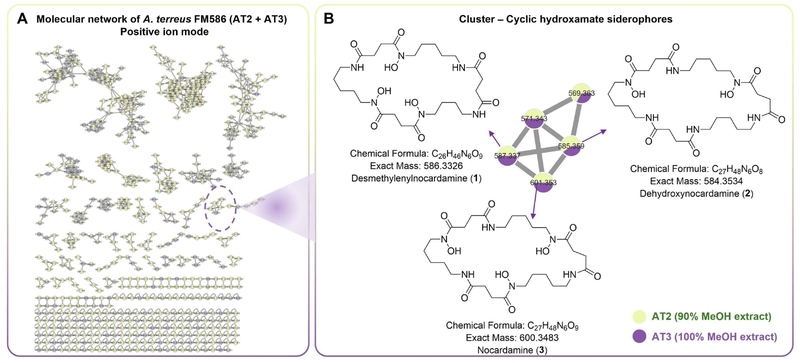
GNPS-based molecular networking analysis of fractions AT2 and AT3 from Aspergillus terreus FM586. (A) Overview of the molecular network. (B) Cyclic hydroxamate siderophore cluster.
The clustering pattern suggested the presence of structurally related hydroxamate siderophores in the 90% and 100% MeOH–H2O fractions (AT2 and AT3). Guided by this molecular cluster, the combined AT2 and AT3 fractions were subjected to targeted purification, leading to the isolation of three cyclic hydroxamate siderophores. Their structures were elucidated as desmethylenylnocardamine (1),16 dehydroxynocardamine (2),16 and nocardamine (3)16 based on HR-ESIMS and NMR spectroscopic analyses together with comparison to published data (Fig. 2).
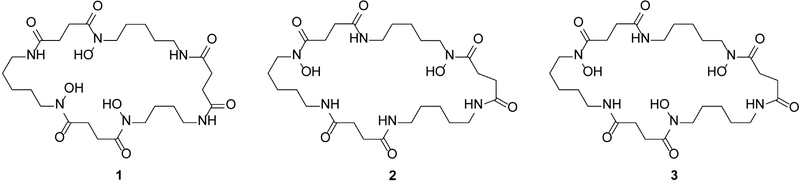
Chemical structures of cyclic hydroxamate siderophores (1–3) from Aspergillus terreus FM586.
To further confirm the hydroxamate functionality of compounds 1–3, Fe(III) complexation experiments were performed, and the resulting complexes were analyzed by HR-ESIMS (Fig. 3). As summarized in Table 1, compounds 1–3 readily formed Fe(III) complexes, giving characteristic ions at m/z 640.2519, 638.2730, and 654.2673, corresponding to [M + Fe − 3H]⁺, [M + Fe − 2H]⁺, and [M + Fe − 3H]⁺, respectively. The observation of [M + Fe − 2H]⁺ for compound 2, rather than [M + Fe − 3H]+ for compounds 1 and 3, is consistent with the dehydroxylated structure of dehydroxynocardamine, which contains one fewer N-hydroxy group and therefore exhibits a different Fe(III) coordination pattern. The observed accurate masses were in excellent agreement with the calculated values for the corresponding molecular formulas. Furthermore, all three complexes exhibited the characteristic isotopic distribution pattern of iron-containing species, providing additional evidence for the hydroxamate functionality and Fe(III) coordination of these siderophores.
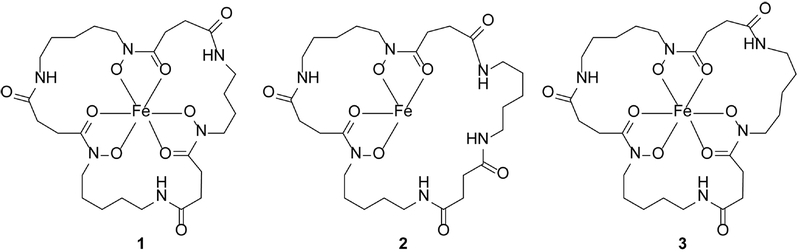
Fe(III) complexation of compounds 1–3.

HR-ESIMS Data for Fe(III) complexes of di- and tri-hydroxamate compounds 1–3
The observed Fe(III) complex formation is consistent with the well-established iron-chelating properties of hydroxamate siderophores. Coordination of Fe(III) through the hydroxamate groups is a characteristic structural feature of this class of metabolites and plays a central role in microbial iron acquisition under iron-limited conditions. From an ecological perspective, the concurrent production of desmethylenylnocardamine (1), dehydroxynocardamine (2), and nocardamine (3) by A. terreus FM586 is noteworthy. FM586 was isolated from marine sediment, an environment in which iron availability can be constrained by the low solubility and limited bioavailability of ferric iron. The production of multiple structurally related hydroxamate siderophores may therefore represent part of the iron-acquisition strategy of this marine-derived strain, potentially enhancing its ability to compete for and utilize available iron under such conditions. Characterization of the corresponding Fe(III) complexes of compounds (1–3) by HR-ESIMS further provides complementary experimental evidence supporting their structural assignments and Fe(III) coordination by these metabolites.
Moreover, the occurrence of three closely related cyclic siderophores within a single molecular family suggests that A. terreus FM586 possesses a secondary-metabolic phenotype capable of generating a suite of structurally related iron-chelating metabolites rather than a single siderophore. Although these compounds have previously been reported and the present study does not establish whether their production is unique to A. terreus FM586, their co-production provides additional insight into the chemical repertoire of this particular marine-derived A. terreus strain. Such strain-dependent variation in siderophore profiles may reflect differences in biosynthetic regulation or environmental adaptation. Further comparative studies involving terrestrial and marine-derived A. terreus strains under defined iron conditions will be required to determine whether this siderophore profile represents a specific adaptation of A. terreus FM586 to its marine habitat.
The successful isolation of three siderophores guided by the molecular networking results demonstrates the utility of this approach for targeting structurally related siderophore analogs. Similar MS/MS fragmentation patterns within a molecular family, combined with differences in precursor masses, can provide useful leads for prioritizing closely related but uncharacterized metabolites for targeted isolation and structural characterization. In particular, once a known siderophore is identified as an anchor within a molecular cluster, neighboring nodes sharing similar fragmentation patterns but displaying distinct precursor masses can be prioritized as candidate analogs with structural modifications. This strategy can reduce the repeated isolation of abundant known metabolites and direct purification efforts toward low-abundance or previously uncharacterized congeners. Furthermore, application of this workflow to a broader range of fungal strains or culture conditions may reveal additional siderophore chemical diversity by expanding the detectable molecular families. Integration of molecular networking with targeted isolation and subsequent spectroscopic characterization may therefore provide a generalizable strategy for discovering novel siderophore analogs from fungi and other microorganisms.
In conclusion, molecular networking using the GNPS platform enabled the efficient identification of a molecular cluster corresponding to cyclic hydroxamate siderophores from the marine-derived fungus A. terreus FM586. Targeted isolation led to the identification of desmethylenylnocardamine (1), dehydroxynocardamine (2), and nocardamine (3). The corresponding Fe(III) complexes were successfully prepared and characterized by HR-ESIMS, providing additional evidence for their Fe(III) coordination by these siderophores. These findings expand the chemical profile of hydroxamate siderophores from A. terreus and further demonstrate the utility of molecular-networking-guided isolation for the targeted isolation of structurally related fungal metabolites.
Acknowledgments
This work was carried out with the support of “Research Program for Agriculture Science and Technology Development (Project No. RS-2026-25518677) Rural Development Administration, Republic of Korea.
Conflicts of Interest
The authors declare that they have no conflicts of interest.
References
-
Zane, H. K.; Butler, A. J. Nat. Prod. 2013, 76, 648–654.
[https://doi.org/10.1021/np3008655]

-
Kalyan, V. R. K.; Meena, S.; Karthikeyan, S.; Jawahar, D. Arch. Microbiol. 2022, 204, 721.
[https://doi.org/10.1007/s00203-022-03322-w]
-
Sah, S.; Singh, R. Agri. 2015, 61, 97–114.
[https://doi.org/10.1515/agri-2015-0015]
-
Carroll, C. S.; Moore, M. M. Crit. Rev. Biochem. Mol. Biol. 2018, 53, 356–381.
[https://doi.org/10.1080/10409238.2018.1476449]
-
Khan, A.; Singh, P.; Srivastava, A. Microbiol. Res. 2018, 212, 103–111.
[https://doi.org/10.1016/j.micres.2017.10.012]
-
Mistry, D.; Gamit, D. World J. Microbiol. Biotechnol. 2026, 42, 395.
[https://doi.org/10.1007/s11274-026-05130-6]
-
Lee, Y. M.; Kim, M. J.; Li, H.; Zhang, P.; Bao, B.; Lee, K. J.; Jung, J. H. Mar. Biotechnol. 2013, 15, 499–519.
[https://doi.org/10.1007/s10126-013-9506-3]
-
Han, Y.; Guo, Y.; Zhang, N.; Xu, F.; Limwachiranon, J.; Xiong, Z.; Xu, L.; Mao, X.-M.; Scharf, D. H. Commun. Chem. 2024, 7, 221.
[https://doi.org/10.1038/s42004-024-01311-2]
-
Gressler, M.; Meyer, F.; Heine, D.; Hortschansky, P.; Hertweck, C.; Brock, M. Elife 2015, 4, e07861.
[https://doi.org/10.7554/eLife.07861]
-
Qi, J.; Chen, C.; He, Y.; Wang, Y. J. Fungi 2022, 8, 1051.
[https://doi.org/10.3390/jof8101051]
-
Gaudêncio, S. P.; Bayram, E.; Lukić Bilela, L.; Cueto, M.; Díaz-Marrero, A. R.; Haznedaroglu, B. Z.; Jimenez, C.; Mandalakis, M.; Pereira, F.; Reyes, F. Mar. Drugs. 2023, 21, 308.
[https://doi.org/10.3390/md21050308]
-
Jang, Y. S.; Kang, D.-M.; Ko, Y.-J.; Ra, M.-J.; Jung, S.-M.; Ahn, M.-J.; Lee, S.; Kim, K. H. Plants 2024, 13, 3603.
[https://doi.org/10.3390/plants13243603]
-
Cho, Y. R.; Hong, J.-H.; Kang, D.-M.; Ko, Y.-J.; Ahn, M.-J.; Kim, K. H. Plants 2024, 13, 3243.
[https://doi.org/10.3390/plants13223243]
-
Joh, Y. S.; Park, J. E.; Ra, M. J.; Jung, S. M.; Yang, G.; Kang, K. S.; Kim, K. H. Pharm. 2026, 18, 807.
[https://doi.org/10.3390/pharmaceutics18070807]
-
Krasnoff, S. B.; Howe, K. J.; Heck, M. L.; Donzelli, B. G. J. Nat. Prod. 2020, 83, 296–304.
[https://doi.org/10.1021/acs.jnatprod.9b00698]
-
Lee, H.-S.; Shin, H. J.; Jang, K. H.; Kim, T. S.; Oh, K.-B.; Shin, J. J. Nat. Prod. 2005, 68, 623–625.
[https://doi.org/10.1021/np040220g]